The 39th AU Summit elevated Water and Sanitation as a Central Pillar of Agenda 2063, but what does this mean for Youth & Economic Justice in Africa? | YTJN
The 39th AU Summit elevated Water and Sanitation as a Central Pillar of Agenda 2063, but what does this mean for Youth & Economic Justice in Africa?
By Lurit Yugusuk - Advocacy and Policy Officer, Youth for Tax Justice Network (YTJN)
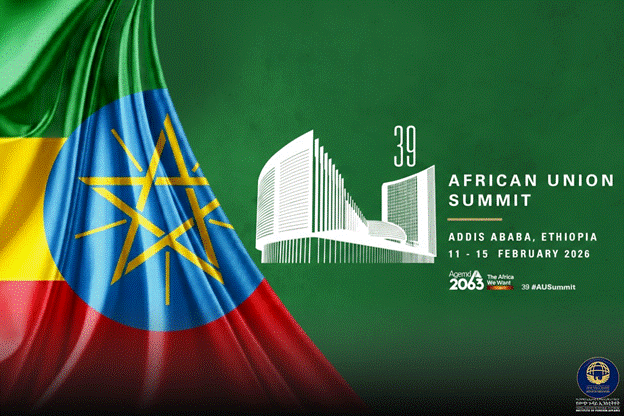
From 11th – 15th February 2026, African leaders gathered in Addis Ababa, Ethiopia for the 39th African Union (AU) Summit under the theme “Assuring Sustainable Water Availability and Safe Sanitation Systems to Achieve the Goals of Agenda 2063.” For the first time, water was elevated as the central theme, with leaders launching the Africa Water Vision 2063 and Policy, aimed at securing water, improving sanitation, and linking these priorities to peace and security, climate resilience, health sovereignty, and economic transformation.
For Africa, this focus comes at a time marked by climate stress, fiscal constraints, and deepening debt vulnerabilities, alongside shifting geopolitical alliances. The summit emphasized moving beyond aspirational declarations toward measurable implementation. Yet beneath the official communiqués and commitments lies a more explorative question:
Related Articles
What does this emphasis on water and sanitation mean for Africa’s youth, and for the broader pursuit of economic justice?
Let’s begin by taking a closer look at the lived realities in the African continent …
Compounding this challenge is the persistent gap between required and available investment in water and sanitation. There is an annual shortfall of approximately US$30 billion to meet the SDG 6 (Clean Water and Sanitation) targets by 2030. To meet the SDG 6 targets, Africa would need to accelerate progress dramatically, by roughly twelvefold for drinking water, twentyfold for sanitation, and forty‑twofold for basic hygiene services, underscoring the urgent need for investment and implementation if the continent’s youth are to have equitable access to essential services and economic opportunity.
Against this backdrop, and considering that approximately 60% of Africa’s population is under the age of 25, the demographic reality points towards the fact that youth remain one of the populations most directly affected by water scarcity and poor sanitation. For young Africans, this translates into tangible, everyday impacts: missed school days due to lack of toilets, limited access to livelihood opportunities in agriculture or small-scale enterprises, vulnerability to waterborne diseases and amplified challenges from climate-induced droughts or floods.
What then is the nexus between water and sanitation, Africa’s youth and the broader pursuit for economic justice?
A closer look at lived realities shows that water, sanitation, and hygiene are not isolated development issues but linchpins of systemic economic and social transformation. Ensuring youth access to these resources creates a feedback loop of empowerment, producing healthier, educated, and economically active young people who strengthen resilient communities, promote equitable growth, and advance sustainable development. The nexus between water, youth and economic justice can be explored across three interconnected dimensions.
The first is human capital and productivity. Reliable access to clean water and sanitation as a basic right and need has direct implications on health outcomes, skill development and school attendance, forming the foundation of human capital. Waterborne diseases, specifically, disproportionately affect youth, causing missed school delays, increased healthcare expenses and diminished future earning potential. Beyond formal education, inadequate access to water and hygiene limits participation in vocational training, apprenticeships and even informal economic activities, restricting opportunities for skill accumulation, innovation, and entrepreneurship. Investments in water, sanitation, and hygiene are therefore not merely public health measures, but they become strategic economic interventions that strengthen the human capital of a generation.
Water scarcity, unreliable access, and poor sanitation, therefore create structural barriers that limit productivity, reduce income potential, and contribute to both underemployment and unemployment among youth. These constraints extend to both the formal and informal economies, trapping communities in cycles of limited opportunity. Conversely, targeted investments in water infrastructure, irrigation systems, and sanitation services can unlock significant income-generating opportunities. Such investments enable youth to expand agricultural yields, engage in aquaculture, operate micro-enterprises, and participate in emerging green sectors. Initiatives like the Great Green Wall and Africa’s blue economy strategy recognized and discussed at the 39th AU Summit demonstrate the potential of linking water management to economic innovation and sustainability. By improving water access and sanitation, communities can create a ripple effect, where youth gain economic independence, local markets are strengthened, and broader economic resilience is cultivated, ultimately advancing equitable growth and sustainable development.
By integrating youth into water governance and decision‑making, therefore, Africa can enhance equitable resource allocation, strengthen institutions, and foster social cohesion. Young people, who are often disproportionately affected by resource scarcity, bring critical local knowledge, innovative solutions, and community leadership that can help reduce tensions and build inclusive water management frameworks. When youth have a voice in planning, monitoring, and accountability mechanisms for water resources, it enhances legitimacy, transparency, and trust in governance systems. This, in turn, contributes to conflict prevention, strengthens social equity, and creates a foundation for long‑term economic justice across the continent.
Where do we go from here?
The AU Summit has laid out a vision, but implementation requires coordinated action across sectors. For Africa’s youth to benefit fully from water security, each stakeholder group must play a role. Specifically:
Governments should prioritize investments in water and sanitation infrastructure, particularly in rural and underserved areas, strengthen transboundary water management to prevent conflict, and integrate youth representation into water governance while linking water access to education, health, and economic empowerment.
Academia and research institutions should generate evidence-based solutions for sustainable water management, develop climate-resilient infrastructure, and support youth-led research and innovation hubs that create practical technologies and policy insights for local communities.
Civil society organizations should advocate for youth-inclusive water policies, monitor progress on AU commitments, and lead community awareness campaigns on hygiene, water conservation, and climate adaptation while partnering with governments to ensure equitable resource distribution.
Youth should actively engage in water governance, entrepreneurship and advocacy, innovate solutions in water management and sanitation services, and hold governments and institutions accountable while leveraging opportunities for skills development and economic participation.
The private sector should invest in water infrastructure, sanitation solutions and technologies that create jobs, and collaborate with governments and communities to develop scalable, youth-centered initiatives that address both water security and economic empowerment.
Collectively, these actions can transform water and sanitation from a basic service into a catalyst for youth empowerment, economic justice, and sustainable development across Africa.
To collaborate with the Youth for Tax Justice Network, reach out to us via: info@ytjn.org.
Related Articles
News
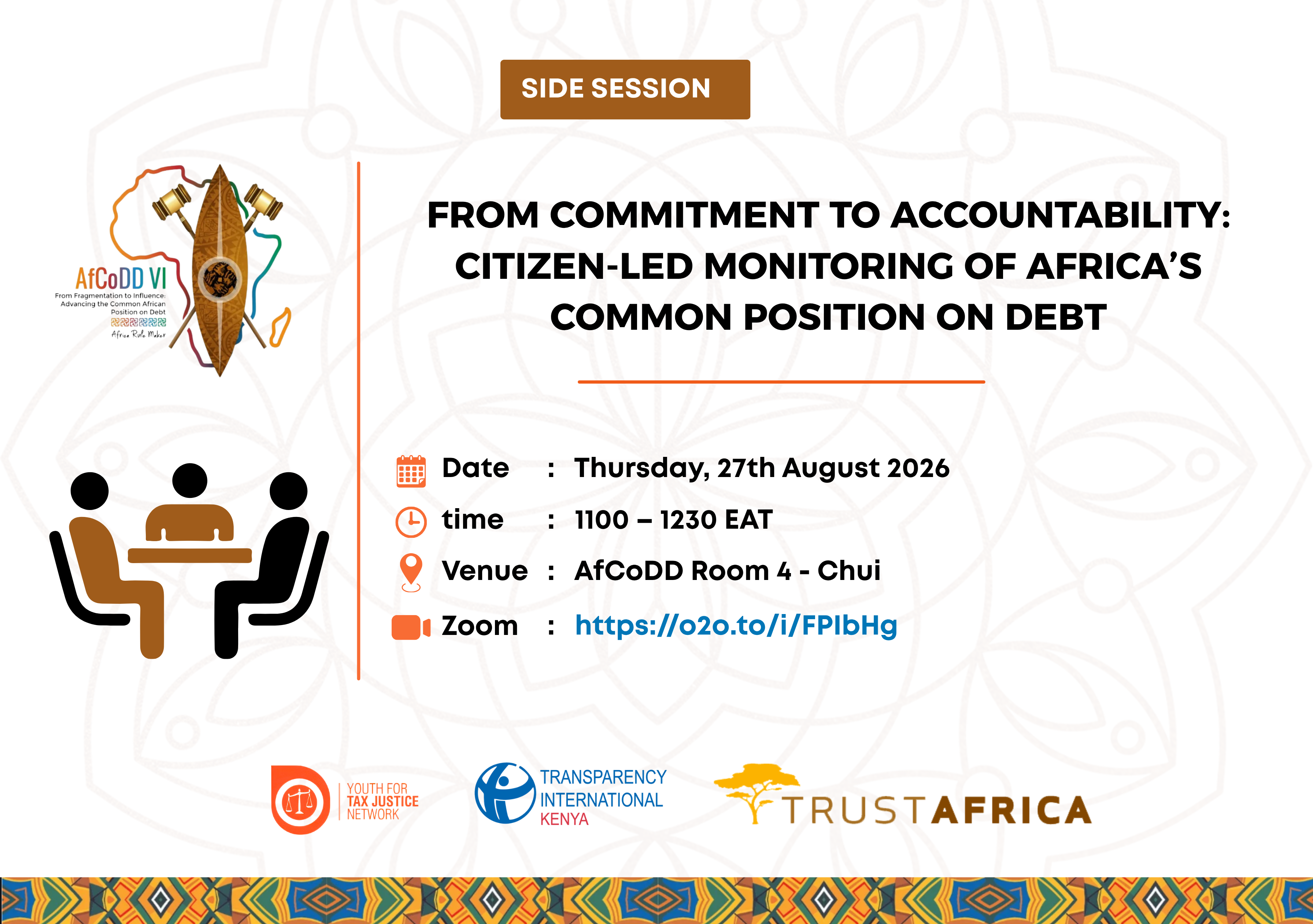
From Commitment to Accountability: Citizen-Led Monitoring of Africa's Common Position on Debt
Youth for Tax Justice Network brings its youth-led monitoring model to this partnership. Young people across Africa carry the weight of debt decisions made today. YTJN insists they...
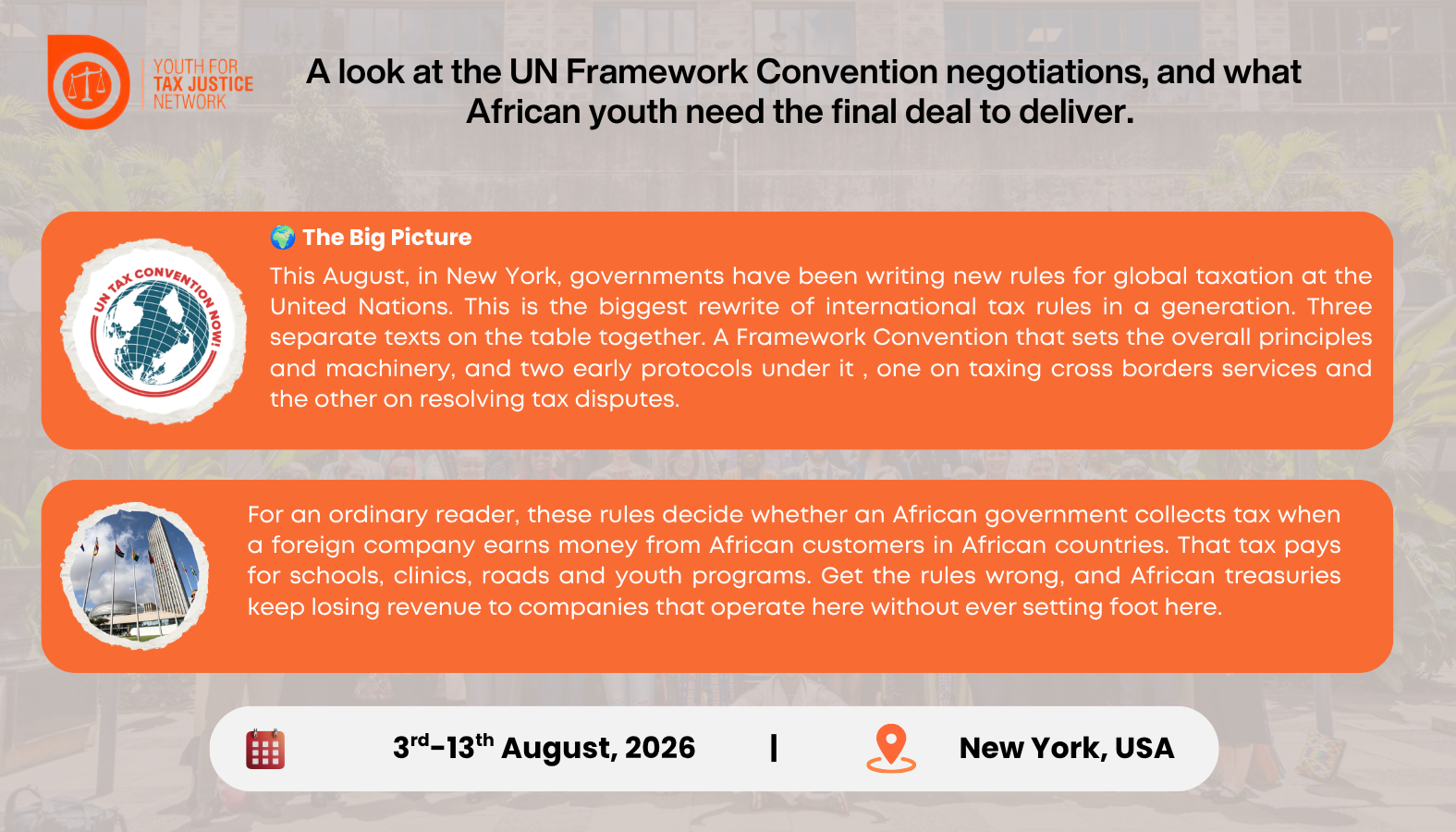
A look at the UN Framework Convention negotiations, and what African youth need the final deal to deliver.
The Framework Convention is the Parent Document. It sets out shared principles and critically; it decides how the whole new system relates to the thousands of existing bilateral ta...
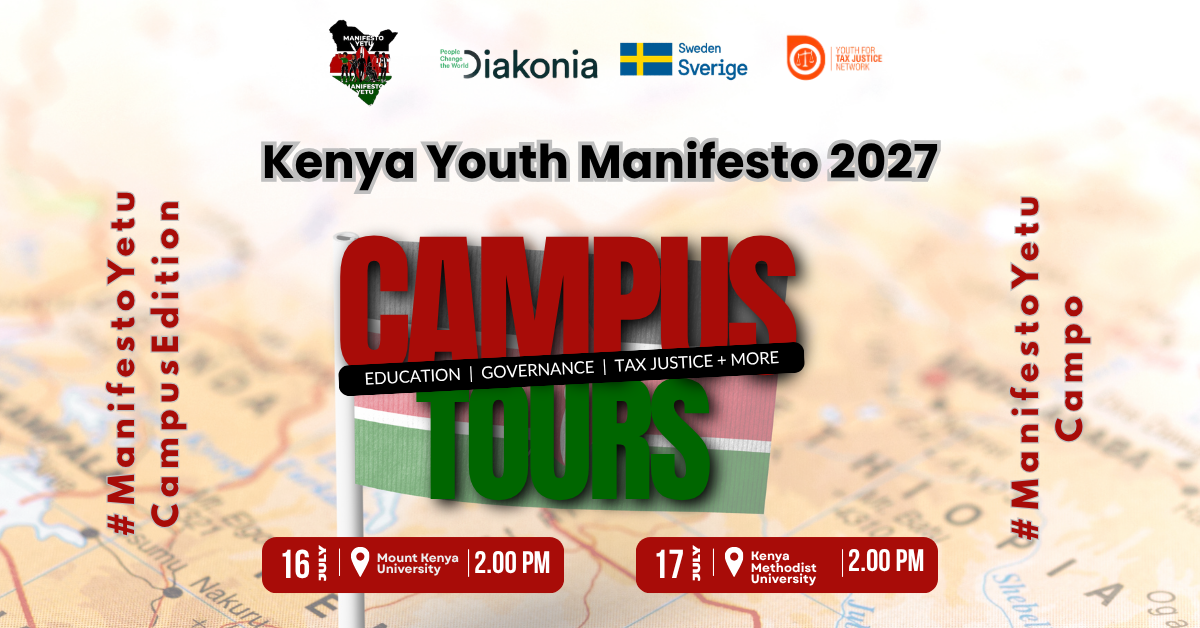
YTJN and Manifesto Yetu Launch University Consultations for the Kenya Youth Manifesto 2027
Youth for Tax Justice Network (YTJN) has partnered with the Manifesto Yetu Initiative to launch university campus consultations across Kenya. The consultations will shape the Kenya...