Advancing Care Economies: Why Fair Allocation of Taxing Rights Matters for Global and Gender Justice
Advancing Care Economies: Why Fair Allocation of Taxing Rights Matters for Global and Gender Justice
By Lurit Yugusuk - Advocacy and Policy Officer, YTJN and Jon Kafuko - Programmes Manager, YTJN
The 10th Global Days of Action on Tax Justice for Women's Rights (GDOA) are finally here. Scheduled to take place from 2nd to 8th March 2026 under the banner “Tax Justice for the Human Right to Care,” this year’s mobilization calls on movements, policymakers, and communities to confront one of the most urgent justice questions of our time on how best we advance and finance care economies.
provides the backdrop for mobilization with the theme:
Rights. Equality. Empowerment. For ALL Women and Girls
. It is a global call to dismantle the structural barriers that perpetuate injustice from discriminatory laws to the harmful social norms that erode the rights of women and girls worldwide. This call resonates deeply with our mission. The struggle for the human right to care is fundamentally a struggle against these very barriers.
As we gather for the 10th edition of the Global Days of Action, we are keen to reflect on a core campaign demand: Fair Allocation of Taxing Rights to Advance Global and Gender Justice. When tax systems are rigged to favor the wealthy and multinational corporations, often through harmful tax competition and secrecy they drain public coffers of the resources needed to build robust, accessible care systems. This is not a neutral failure; it is a structural barrier that deepens gender inequality, forcing women and girls to shoulder the burden of unpaid care work.
Demanding a fair allocation of taxing rights is therefore a direct action to dismantle this barrier. It is how we ensure that governments have the fiscal space to legislate, fund, and protect the right to care for ALL women and girls, moving us from rhetoric to reality.
Before we get right into it, we must establish that the care crisis is a fiscal crisis in itself…
Care work, which is the ever-present yet invisible thread woven through every day, takes on a monumental role in our lives. Still, the global social organization of care crisis is one of the most urgent yet least addressed dimensions of gender inequality. Across the world, women and girls shoulder the heaviest burden of unpaid and underpaid care work, from sustaining households, communities, to economies while absorbing the failures of underfunded public systems intended to provide rights-based services such as healthcare, social protection and education, among several others.
A feminist analysis reminds us that this crisis is not accidental, but is instead the outcome of tax and fiscal systems that systematically undervalue social reproduction, privatize risk, and prioritize capital over people. Under these conditions, care is erased from macroeconomic policy and treated as a private responsibility of women rather than a public good. As states disinvest in care infrastructure, social protection, and public services, care becomes commodified, public systems shrink and women and girls are forced to stretch their time, labour, and bodies to compensate.
What about the global tax system … What does the Structural Bias against Source Countries look like and How does it fuel gender inequality?
Recent data show that the global tax system systematically disadvantages countries where economic activity actually occurs, often in the Global South, and benefits where multinational corporations and High Net Worth Individuals (HNWIs) are headquartered … in the Global North.
Meanwhile, the global tax system has steadily shifted the burden away from wealth toward consumption. In high-income countries, top corporate and personal income tax rates have dropped significantly over recent decades even as wealth concentration skyrockets. Oxfam, in a recent report further highlights that less than 8 cents in every dollar raised in tax revenue in G20 countries now comes from taxes on wealth. By comparison, more than 32 cents in every dollar (over four times as much) is collected from taxes on goods and services (VAT). These trends mean that governments lose out on critical revenue while women absorb the social costs.
These imbalances are rooted in how international tax rules are designed. Under current frameworks and restrictive tax treaties, taxing rights tend to favour residence countries, primarily in the Global North, even when profits are generated in source countries in the Global South. This means that workers, natural resources, environmental impacts, and care responsibilities remain local, but the revenues generated from them are not retained where they occur. Source countries are left with less fiscal space to invest in public services, including care infrastructure, healthcare, and education, which are all services that most directly support gender equality and public well‑being.
How then do we reclaim fiscal sovereignty and ensure the fair allocation of taxing rights?
Doing this goes beyond debates about tax codes and recognizing that it is not merely a technical discussion, but a struggle over power: who holds it, who is denied it, and who gets to decide the future of our care. For decades, a global minority has rigged the rules to hoard resources through vague and exclusionary concepts such as “value creation,” which privileges the Global North at the expense of the Global South. These frameworks obscure the real sites of economic activity and social reproduction. At the same time, countries in the Global South are often forced to choose between paying down debt and investing in the people who sustain life, overwhelmingly women and girls.
Reclaiming fiscal sovereignty means dismantling the architecture that has enabled this. It means anchoring tax rights not in the fictional "value" of paper profits, but in the real economy where people work, produce, extract, and consume. It means insisting that where economic activity happens is where revenue must belong.
The ongoing negotiations toward a United Nations Framework Convention on International Tax Cooperation (UN Tax Convention) is our generation's chance to rewrite these rules. The current draft, however, falls short of delivering an inclusive, equitable, and rights-based system capable of addressing structural inequalities, particularly those rooted in gendered divisions of labour and care. It risks enshrining a two-tier world where wealthy nations continue to dictate terms while developing countries are left to manage the crisis of care with empty hands. Thus, civil society, youth groups, women rights organizations and member states, among key stakeholders must demand:
A convention anchored in source-based taxation, ensuring that countries where resources are extracted and labour is performed have the first and final right to tax.
A framework that recognises real economic presence over shell companies and paper trails.
A system that treats tax justice not as an end in itself, but as the financial bedrock of the human right to care, for universal healthcare, public education, social protection, and the recognition of unpaid care work as the invisible engine of all economies.
The question before us is simple: Will the UN Tax Convention dismantle the structural barriers to gender justice, or will it become another chapter in the long history of broken promises?
We choose action. We choose justice. And we will settle for nothing less than a tax system that funds the care economy our world cannot live without.
Related Articles
News
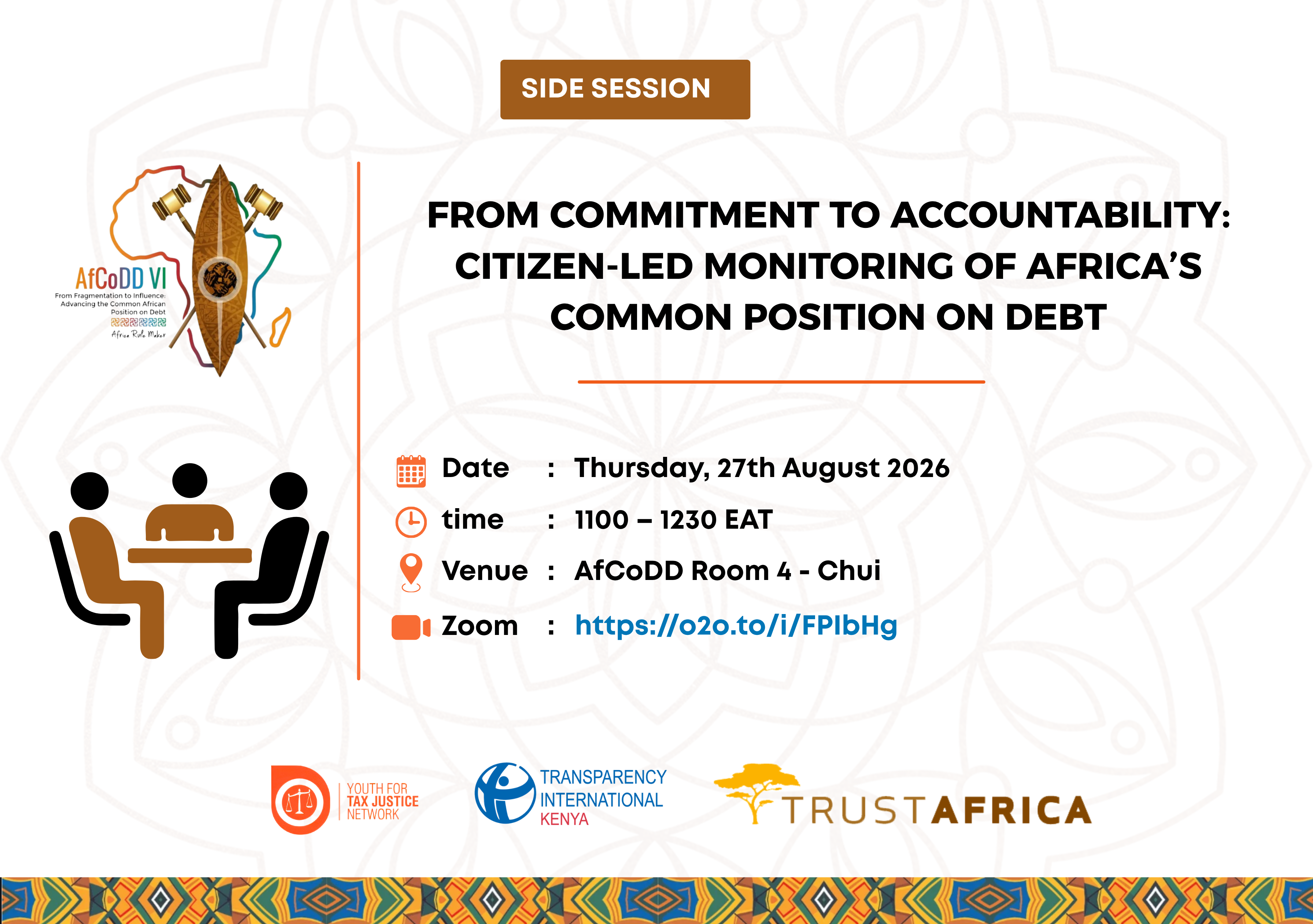
From Commitment to Accountability: Citizen-Led Monitoring of Africa's Common Position on Debt
Youth for Tax Justice Network brings its youth-led monitoring model to this partnership. Young people across Africa carry the weight of debt decisions made today. YTJN insists they...
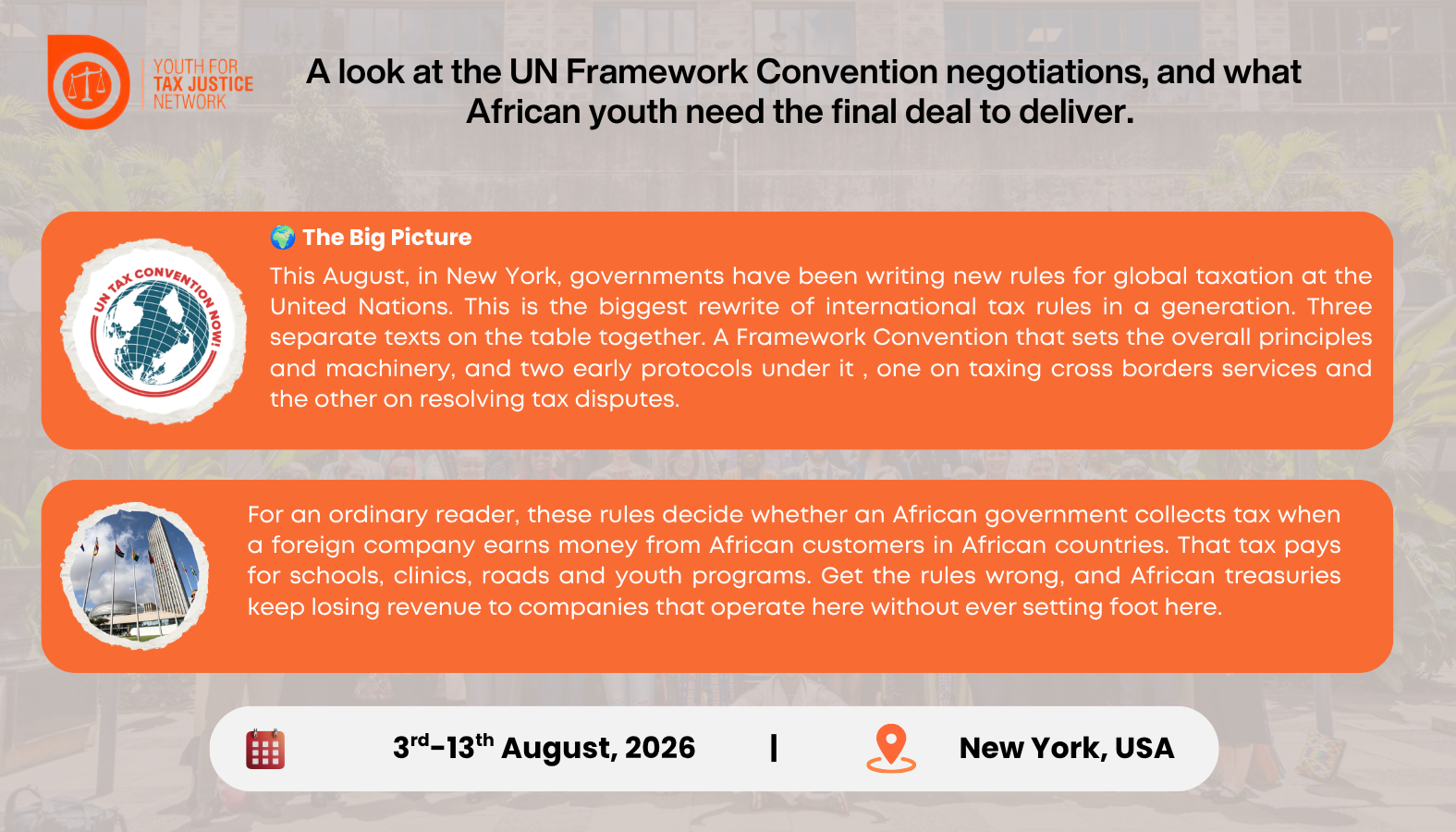
A look at the UN Framework Convention negotiations, and what African youth need the final deal to deliver.
The Framework Convention is the Parent Document. It sets out shared principles and critically; it decides how the whole new system relates to the thousands of existing bilateral ta...
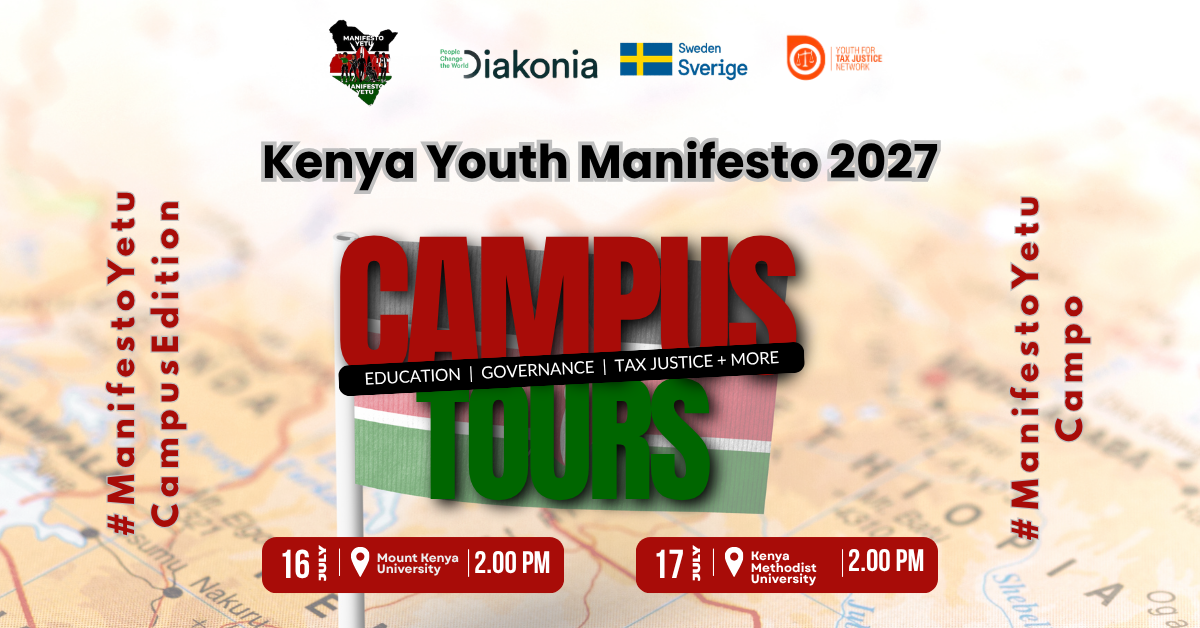
YTJN and Manifesto Yetu Launch University Consultations for the Kenya Youth Manifesto 2027
Youth for Tax Justice Network (YTJN) has partnered with the Manifesto Yetu Initiative to launch university campus consultations across Kenya. The consultations will shape the Kenya...