Africa Day and the Development Promises Still Owed to Youth
By: Ssemujju Lewis, Communications Officer, Youth For Tax Justice Network
In 1963, the Organisation of African Unity (now; African Union) was established, and each year on 25th May, Africa stops to commemorate the occasion. The flags go up. The speech presentations are made. The story of the continent is proudly retold. Africa Day is much more than a date for those who make up more than 60% of Africa's population – the young people. It is a reckoning. It's time to ask whether or not the commitments made in 1963 and reiterated by Agenda 2063 and enshrined in the Sustainable Development Goals are being fulfilled.
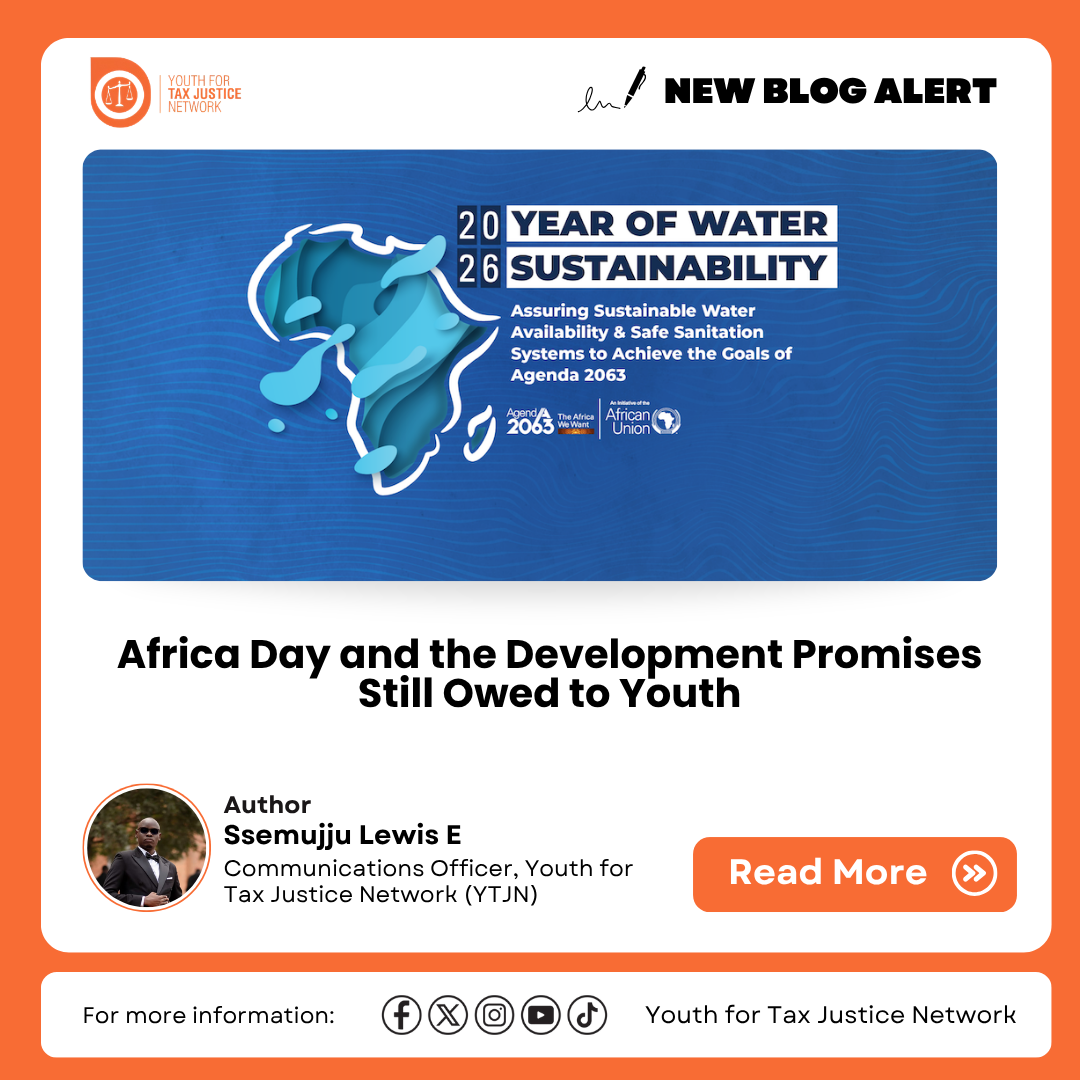
The theme for this year's Africa Day is 'Assuring Sustainable Water Availability and Safe Sanitation Systems to Achieve the Goals of Agenda 2063,' which calls for honesty. This theme revolves around three SDGs. SDG 6 calls for clean water and sanitation for everyone. This SDG (10) aims to decrease inequalities. SDG 16 is to ensure accountable institutions and inclusive governance. They are not only development targets, but together, their qualities are a blueprint for the good Africa that young people deserve. Sadly, this blueprint is broken these days.
Related Articles
SDG 6; Water is a Right Being Denied!
First, let the numbers tell the tale. In 2022, only 31% of the sub-Saharan population used safely managed drinking water compared to the average of 73% at global level. The figure decreases to 24% in the region, compared to the global average of 57%, for safely managed sanitation. By contrast, 74% of people in South Asia used improved sanitation and 95% of people in South Asia had access to potable water. No development quirk exists between Africa and the rest of the world. It's a governance issue that is costing ordinary folk every day.
The number of people who lack access to basic drinking water in Sub-Saharan Africa is increasing, the only region in the world where this is the case. It's a tragic reality to have to face on Africa Day. Sanitation progress has been virtually stagnant, with just about the same number of people accessing it in 2015 (about a third) as in 2024. This has not been matched by the growth in population, meaning that in 2024, there are more people lacking basic sanitation than there were in 2015 (686 million in 2024 versus 803 million in 2015).
A young girl without access to a school toilet will miss school when menstruating. A young man in an informal settlement who must drink water from a polluted water source suffers unnecessary health consequences, causing him to lose income and time. Women and girls, in most countries where data is available, are the primary collectors of water, and they collect water for more than 30 minutes of the day, on average. That's time devoted to another purpose, time taken out of school, time out of the workplace, time out of a future. Truly, SDG 6 is NOT a water goal. It's a youth opportunity goal!
Poor sanitation reduces the GNP of sub-Saharan Africa by about 5% of its total GDP each year, which is about USD 170 billion. That doesn't mean that money disappears. It is manifested in lost productivity, increased health expenses, reduced school attendance, and retarded economic growth. Water is not in the budget priority queue due to the cost of political decisions. And it's the youth of Africa that pay that price longest. ISS African Futures
SDG 10: Inequality Is a Fiscal Architecture
To ensure that all countries achieve the goal of reducing inequalities within and between countries, SDG 10 requires action. Information on inequality in Africa is an alarming call to action.
Any dollar that goes out the door illegally is a dollar that isn't spent on a water treatment plant, a sanitation facility, a public school, a health clinic, or other public goods and services. The communities that are left without infrastructure are predominantly youthful, rural, female, and impoverished. There's no natural reason why there's inequality in Africa. It is a product of fiscal systems in which wealth is able to flow out of the system without being taxed, and public services are not paid for.
This is being passed to the young people of Africa all over the continent. They are joining labour markets that are defined by the type of public infrastructure that their communities have been given. They are relinquishing funds into systems that siphon resources away from what that funding is supposed to go to, and towards debt repayment. They are being called upon to construct futures on shaky foundations, which are being undermined by the fiscal structure of the continent. It's no coincidence. It is one of the policy results. Policy outcomes are things that can be changed through advocacy, organising, and political pressure.
SDG 16: Accountability as the infrastructure that no one sees.
Peaceful, just, and inclusive institutions are the backbone of SDG 16. It is the SDG that makes all the others possible. Lack of clear public finances leads to water budget misallocation. With no accountability, sanitation projects are funded on paper and forsaken on the ground. Without inclusive decision-making, the communities most in need of infrastructure remain invisible to the people writing the budgets.
African youth have been routinely marginalized from decision-making around the use of public funds. They are not consulted when a budget consultation is undertaken. Youth involvement in parliamentary debates is next to non-existent. Youth voices are either absent or minimally symbolic in rooms for international negotiations on tax, climate finance, and funding for development.
This exclusion has repercussions that are not limited to any one budget cycle. African development is being hampered by the loss of foreign exchange from the continent due to IFFs, the contraction of domestic resources, the undermining of trade development and macroeconomic stability by corruption, and the deepening of poverty and inequality. Lack of effective audit institutions means a lack of accountability for communities' promises. Legal and political barriers exist in several countries for the implementation of public money, followed by civil society actors. Much of the SDG 16's infrastructure of accountability is still being built on much of the continent.
Yet, this is where the activism of Africa Day thrives! There was no waiting to be invited into these spaces by the young people. They are helping to make their case, visiting budget hearings, creating their own tax studies, and participating in negotiations on tax at the UN. There are tools at hand for accountability. They have to be used, and an organised, sustained pressure is needed.
A Celebration That Can't Be Foreseen.
It is an important day to celebrate; it's Africa Day. Much progress, in fact, has been made on the continent since 1963. There has been an improvement in life expectancy. There has been an improvement in literacy rates. At present, democratic institutions are found in many more states than at the time of the founding of the OAU, although some of these are weak. That's an achievement that should be applauded.
So, celebration should not be without honesty, otherwise it is degrading the dignity of 803 million people living without basic sanitation. It is a disrespect to the USD 88.6 billion that leaves Africa annually in the form of illicit financial flows. It brings discredit to the young women who have to spend hours fetching water rather than taking part in classroom hours. It offends the young people who are growing up in societies that have not been fully funded for water provision, nor adequately addressed issues of inequality or held accountable for their own, in the name of youth.
SDG 6, SDG 10, and SDG 16 are promises given to the people of Africa; promises of the hundreds of millions of young Africans who will be around in 2063 when Agenda 2063 is expected to be completed. For those promises to be fulfilled, it is upon the decisions that are taken right here, in the budget offices, in the parliaments, in the tax authorities, and in the negotiating rooms of the international community.
The AU was not designed as an “out of the box” product by the founding generation of Africans. It was constructed as a base. That foundation is what is built upon now, and it's their responsibility. Every year, Africa Day asks: Can the systems on this continent allow them to build it? According to the data, no, not yet.
These problems are also solvable. The data on water, inequality and accountability does not indicate a continent that cannot tackle them. It highlights systems that need to be fixed, and young people can fix them.
Here is where the work should be done.
Call for transparency in public budgets.
The problem with water and sanitation projects is not the lack of money; it's the lack of accountability over money. Youth in Africa must hold their governments accountable for the allocation of funds for water and sanitation and other public services in a way that is accessible to the public and allows them to ask questions. Transparency of the budget is a non-technical requirement, but an elementary rule of government. Just like Youth for Tax Justice Network (YTJN), organizations should ensure that in all interactions with national governments and regional bodies, the youth are represented.
Follow the money on IFFs.
Every year, USD 88.6 billion is lost from Africa through illicit financial flows. It is the water treatment facility that has never been constructed. It is the sanitation facility that is still in a planning document. Youth should be made aware of the nature of tax evasion, profit shifting, and corrupt financial arrangements and empowered to mobilise against them. Connecting youth communities to the facts about IFFs is how you turn anger into advocacy.
Take up seats in the Decision-Making Rooms
Youth are under-represented in places where decisions are made about resources: Budget consultations, Parliamentary debates, and international tax negotiations. It's not a coincidence that the absence is. It will take action and pressure to reverse it. Youth advocates need to be present at budget hearings, provide formal input to government processes, and develop technical knowledge to be able to engage in fiscal policy, tax reform, and development of financing discussions in a credible manner. We are glad that spaces like this are opening in Uganda and Botswana, and we look forward to even more countries following suit.
Form coalitions on multiple issues.
Water is a gender issue. Sanitation is truly an educational problem. IFFs are a health concern. These are all structural relationships. It is more difficult to ignore youth movements that coordinate these issues or to make them less effective in terms of shifting policy. But Pan-African networks should be designed to do just that – cross-issue coalition building and put that infrastructure to good use.
Ensure Governments can be held to their own commitments.
Agenda 2063 is a promise that must be made a reality. SDGs are a commitment. Africa Day is an appropriate time to assess problems of promise and reality. The youth have a crucial role in monitoring, reporting, and calling governments to account on their pledges to water, inequity, and accountability. There is no place for the luxury of civil society monitoring. When there are poor formal accountability systems, it is the main instrument communities have at their disposal.
Related Articles
News
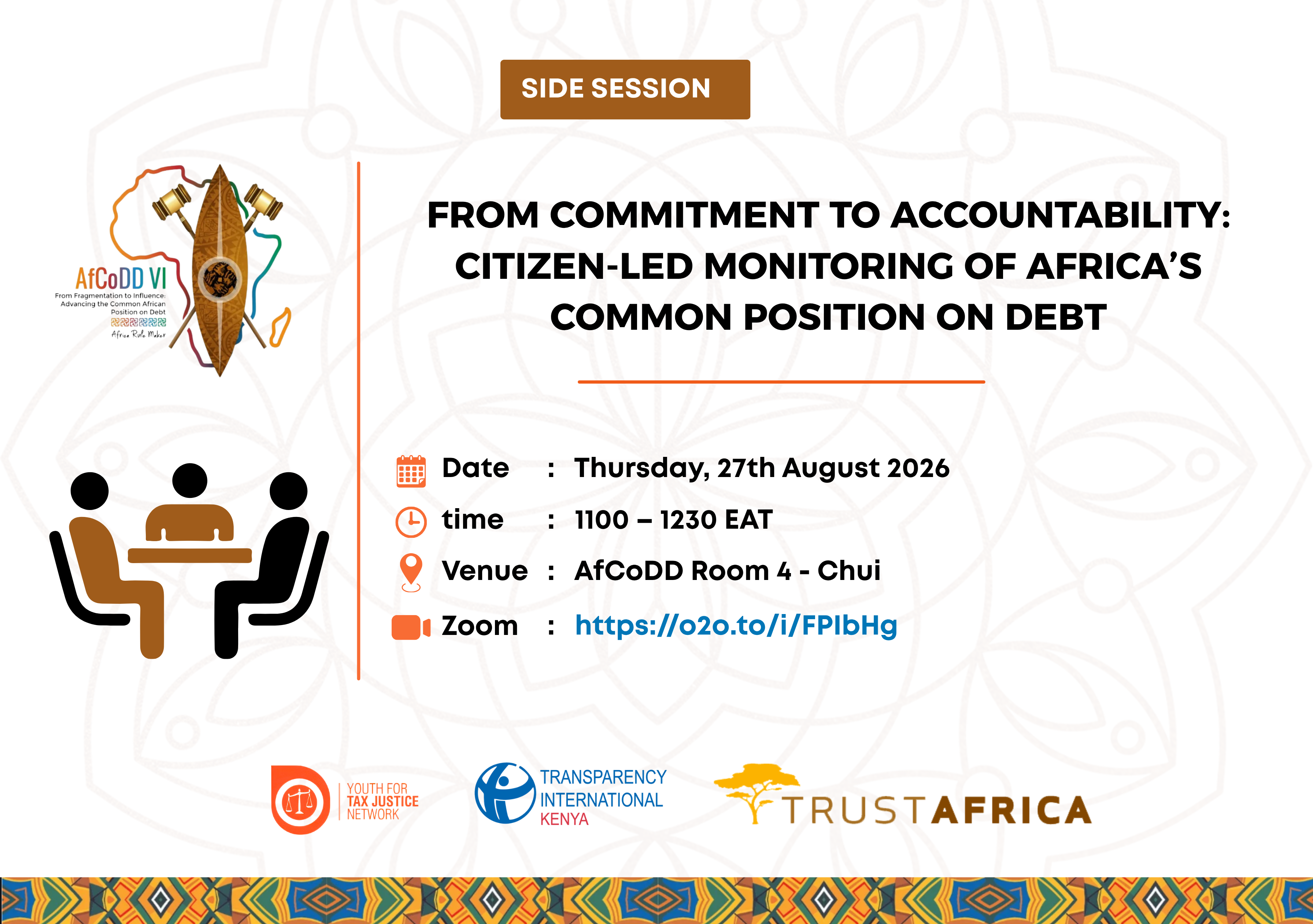
From Commitment to Accountability: Citizen-Led Monitoring of Africa's Common Position on Debt
Youth for Tax Justice Network brings its youth-led monitoring model to this partnership. Young people across Africa carry the weight of debt decisions made today. YTJN insists they...
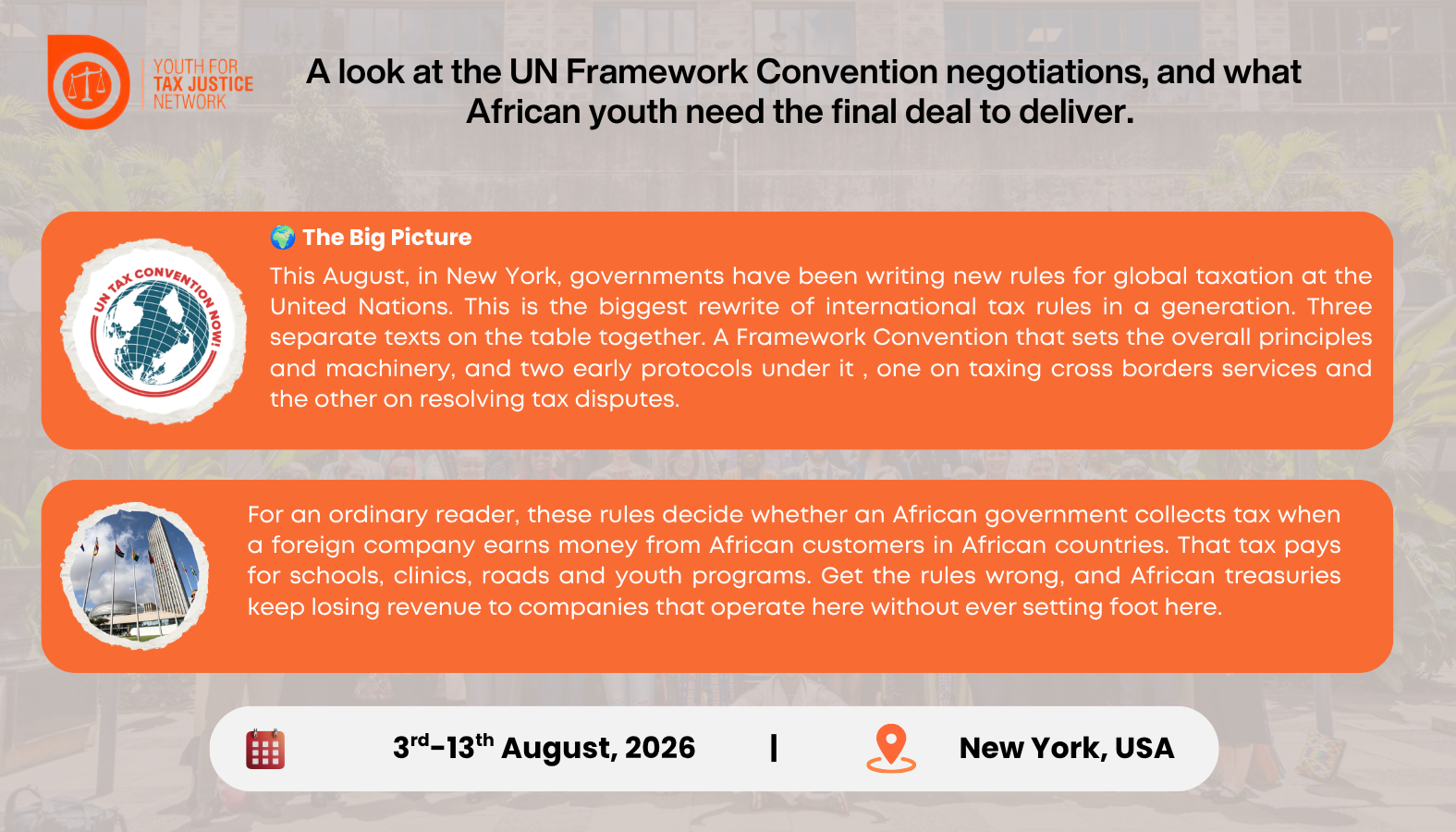
A look at the UN Framework Convention negotiations, and what African youth need the final deal to deliver.
The Framework Convention is the Parent Document. It sets out shared principles and critically; it decides how the whole new system relates to the thousands of existing bilateral ta...
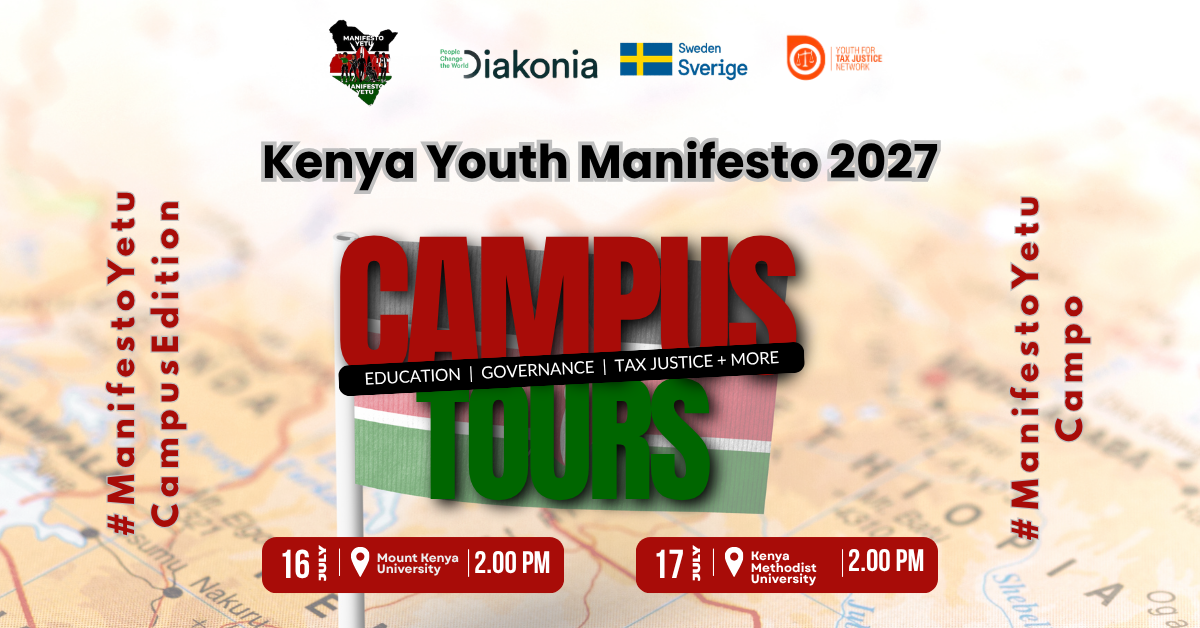
YTJN and Manifesto Yetu Launch University Consultations for the Kenya Youth Manifesto 2027
Youth for Tax Justice Network (YTJN) has partnered with the Manifesto Yetu Initiative to launch university campus consultations across Kenya. The consultations will shape the Kenya...