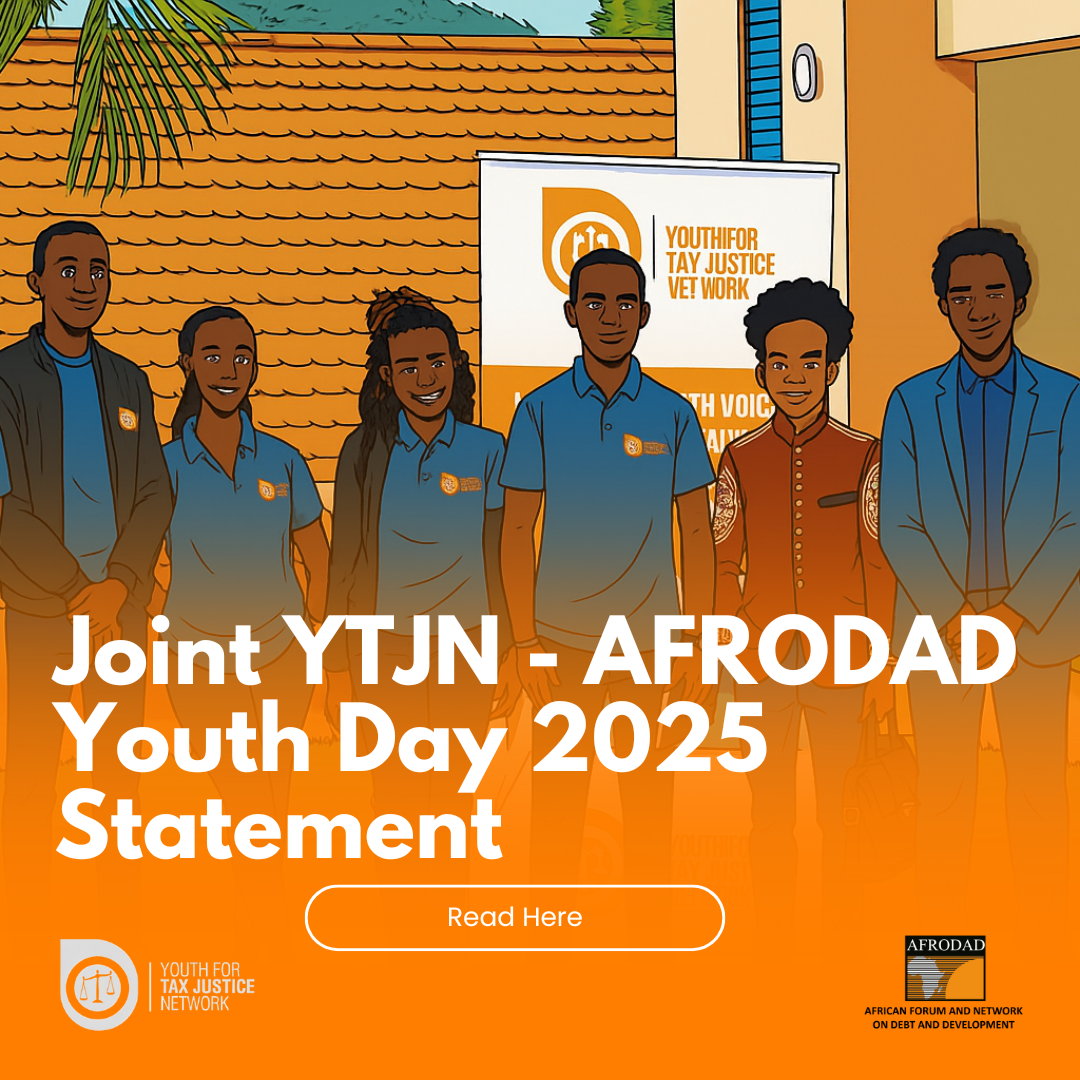
Issued by Youth For Tax Justice Network (YTJN) and the African Forum and Network on Debt and Development (AFRODAD ) • 12 August 2025 On this International Youth Day 2025 , we celebrate Africa’s greatest resource, which is its youthful population , and with its active and full participation, Africans can surmount their difficulties.We stand united across borders and cultures to celebrate youth in Africa and beyond. Africa, as the youngest continent with over 400 million youth , is witnessing a surge in youth-driven technological innovation. African youth are leveraging entrepreneurial skills to create jobs and address local challenges. The Global Entrepreneurship Monitor (GEM) reports that Africa has the world’s highest entrepreneurship rate, with 22 per cent of working-age Africans involved in early-stage entrepreneurial activity. Additionally, youth in Kenya , Nigeria, Uganda and other countries are taking action by influencing policy and law-making processes at national, regional, and global levels, tracking budgets, exposing illicit financial flows, mobilising for fair royalties in extractive communities , advocating for sustainable climate finance , and building climate adaptation and resilience from the ground up. Ibrahim Traoré, President of Burkina Faso, is Africa’s youngest current head of state, but also the world’s youngest. Nonetheless, our local initiatives cannot support Agenda 2063 if the global regulations continue to deplete the very resources our communities rely on. The biggest challenge in the labour market for youth in Sub-Saharan Africa is the scarcity of productive and decent employment opportunities. In 2023, the NEET (not in employment, education, or training) rate for youth in Sub-Saharan Africa was 21.9 per cent, which was higher than the global rate of 20.4 per cent. This region is one of only three worldwide that has been assessed as off track regarding its Sustainable Development Goal commitment (specifically target 8.6) to reduce the population of young NEETs. The absence of quality job opportunities puts many young Africans at risk of poverty, forced migration, and engagement in illegal activities. Fair taxation and just debt rules are what turn local youth action into lasting national transformation. Across the Global South, unsustainable sovereign debt is stripping public budgets from education, healthcare, climate adaptation and resilience, and decent work, core pillars of the Agenda 2063 of the Africa We Want and the foundation of our future. As the Harare Declaration states, the African youth bulge as an engine for the continent’s structural transformation agenda is at risk of being a missed opportunity due to being saddled with accumulated debt, while potentially being locked out of accessing finance that is desperately needed to invest in them, and making them carry the burden of a mortgaged future. Instead of investing in our potential, governments are forced to divert billions to creditors, too often to lenders who prioritise profit over people. This is not only an economic imbalance; it is a generational betrayal. We thus demand debt and tax justice that put people and the planet first. We are the generation living with the consequences of choices we did not make, yet we carry their costs into our classrooms, health centres, climate resilience projects, and the jobs we are still fighting to find or create. The ongoing negotiations toward a UN Tax Convention are a once-in-a-generation chance to fix a rigged system . We call for a genuinely inclusive, intergovernmental process that curbs tax abuse and illicit financial flows, rebalances taxing rights toward developing countries, ensures multinationals and the ultra-wealthy pay their fair share, and guarantees transparency that empowers citizens and youth to hold power to account. Global tax rules should serve the SDGs by funding schools, clinics, climate resilience, and dignified work, not hollow them out. Sovereign debt requires the same courage. Patchwork, creditor‑led fixes keep countries trapped in cycles of austerity that punish young people most. We therefore call for a UN Framework Convention on Sovereign Debt that delivers a predictable, impartial, and human‑rights‑based system for preventing and resolving debt crises, one that centres development, climate justice , and intergenerational equity. We will not accept a system that sacrifices our future for the errors and exploitation of the past . We will continue to organise, speak truth to power, and design solutions worthy of our generation’s hopes. Our Demands: As the African Borrowing Charter states, governments must sustainably balance public debt levels with the necessity to accelerate inclusive development and enhance public service delivery for youth and all Africans. This is achieved through the promotion of local youth-driven action , through prioritising public investment in youth-led development, green and care economy jobs, digital access, and social protection so that local initiatives can scale and endure. Guarantee youth participation : Embed youth representation and accountability mechanisms in tax and debt decision‑making from local budget processes to global negotiating rooms. The Harare Declaration demands cancellation and restructuring of debt: Deliver timely, comprehensive debt cancellation and restructuring that protects essential public services, climate action, and decent work, with automatic payment suspensions during crises. Conclude a robust UN Tax Convention : Secure an inclusive, universal, and binding convention that reduces tax abuse and illicit financial flows, rebalances taxing rights, mandates public beneficial ownership and country‑by‑country reporting, and strengthens domestic resource mobilisation for the SDGs. Establish a UN Framework Convention on Sovereign Debt : Create a fair, transparent, and rights-based global mechanism with independent decision-making, climate- and disaster-responsive clauses, and meaningful participation by affected communities, especially youth and women. On this day, we reaffirm that young people are not passive inheritors of debt; we are active architects of a fairer, freer future. Local youth actions towards the Africa We Want will go further and last longer when global tax and debt rules finally serve justice. We are ready to build our future! Authored by Jon Kafuko, Programs Manager, Youth For Tax Justice Network (YTJN) and Fidelite Nshimiyimana, Campaigns & Communications Manager, African Forum and Network on Debt and Development (AFRODAD )